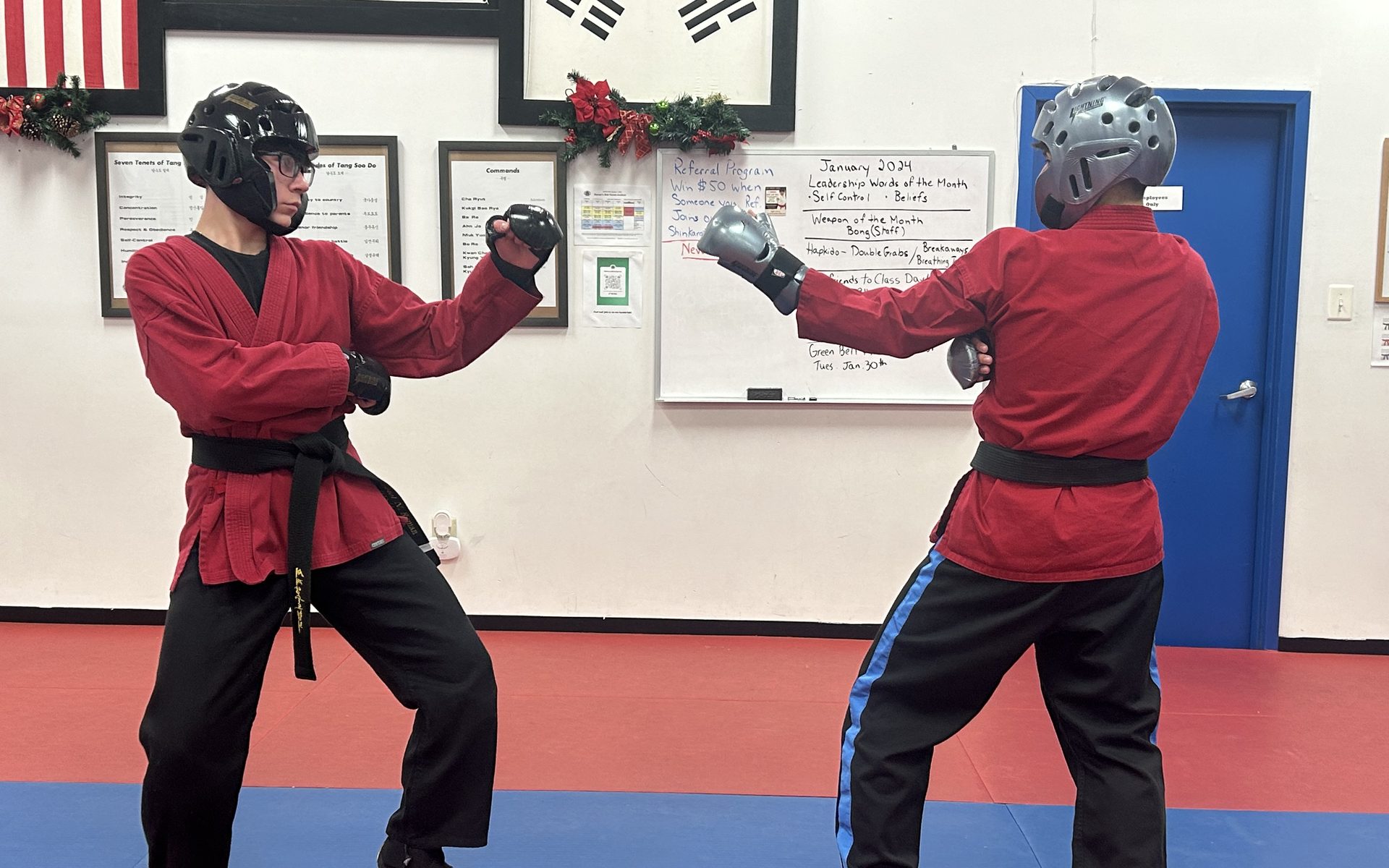
It's a common fear, especially for women or smaller-statured adults. In a confrontation, does the bigger, stronger person always have the advantage? It’s a question that can cause real anxiety, making a simple walk through a parking lot in Hamilton or a late night at the office feel unsettling. We often assume that self-defense is a game of brute force, a contest of muscle that we are destined to lose.
But what if that assumption is wrong? What if there was a system of self-protection designed not around clashing force with force, but around redirecting it? This is the core philosophy of Hapkido, a comprehensive Korean martial art that serves as the ultimate equalizer. At Roman's Shin Karate, we teach our adult students that the most powerful weapons they have are knowledge, leverage, and timing.
Hapkido self-defense isn't about being stronger than an attacker; it’s about being smarter. It’s a discipline that empowers individuals of any size or gender with the confidence and skill to protect themselves effectively. This art transforms your understanding of power, proving that a well-executed technique is more impactful than raw strength ever could be.
What is Hapkido? More Than Just Kicks and Punches
When people think of martial arts, they often picture high kicks and powerful punches. While those are components of many disciplines, including the Tang Soo Do we teach, Hapkido offers a different and more complete perspective on personal protection. The name itself, "Hap Ki Do," translates to "The Way of Coordinated Power." It’s an art built on the principle of using an opponent's own energy against them.
Unlike arts that primarily focus on linear, offensive strikes, Hapkido is fluid and circular. It is a comprehensive system designed for realistic self-defense scenarios. A Hapkido practitioner learns to blend with an attacker's motion, redirecting their force to unbalance, control, and subdue them through a variety of techniques that don't depend on muscular strength.
The Three Core Principles of Hapkido
Our teaching of Sin Moo Hapkido is rooted in three fundamental concepts that illustrate how it works:
- The Water Principle (Yu): Like water, a Hapkido student learns to be fluid and adaptable. Instead of meeting a punch with a rigid block, you absorb and redirect the energy, flowing around the attack to find an opening. You are not a rock being broken by a wave; you are the current that pulls the wave in a new direction.
- The Circle Principle (Won): Movement in Hapkido is rarely in a straight line. By using circular motions, practitioners can amplify their own force and efficiently disrupt an attacker's balance. This principle allows a smaller person to generate incredible power and control a larger opponent’s momentum.
- The Harmony Principle (Hwa): This is the principle of non-resistance. Instead of clashing directly with an attacker's force, you harmonize with it for a moment, blending with their movement before redirecting it. This allows you to seize control of the situation with minimal effort.
The Great Equalizer: How Technique Beats Size
This is the heart of Hapkido self-defense and why it is so effective for adults of all body types. The entire art is a study in physics and anatomy, applied to personal protection. At our dojang in Hamilton, we see the lightbulb go on for students when they realize they don't have to overpower someone to stay safe. They just have to apply the right technique.
Joint Locks and Pressure Points
A key component of Hapkido is the use of joint locks on the wrist, elbow, and shoulder. These techniques don't require strength because they target the natural limitations of the human body. A small, precise twist on a wrist, applied correctly, can bring the largest and most aggressive person to their knees. It’s not about muscle; it's about knowing exactly where and how to apply pressure. This knowledge is a true equalizer.
Throws and Sweeps
Have you ever seen someone trip over a small object? Their entire body, regardless of its size, goes crashing down. Hapkido throws operate on a similar principle. You are not lifting your attacker. Instead, you are using their own forward momentum and circular redirection to take away their balance. By disrupting their center of gravity, you can execute a throw or sweep with what feels like minimal effort. Their own weight and energy do most of the work for you. Our Hapkido classes focus on these exact principles.
Leverage, Not Lifting
Think of a crowbar. With a long enough lever, a single person can lift a car. Hapkido applies this same principle of leverage to the human body. By using your limbs and body positioning correctly, you create levers that can manipulate and control an opponent far stronger than you. It is a system built on scientific principles, not just fighting spirit. This approach makes it one of the most practical self-defense skills an adult can learn.
A Real-World Scenario: A Story from Our Dojang
We recently had a parent join our adult program. She was a professional working in Trenton and often felt anxious during her commute, especially on darker winter evenings. She was not a large person and admitted she joined because she felt completely defenseless against a potential threat. For the first few weeks, she was hesitant, worried she wasn't strong enough to make the techniques work.
The turning point came during a partner drill. She was paired with a larger, more experienced male student who was simulating a two-handed grab. Following the instructor's guidance, she used a circular motion to escape the grip, pivoted her body, and applied a simple wrist lock. The look of shock on her face, and on her partner’s, was immediate. He tapped out, acknowledging the technique's effectiveness.
She didn't overpower him. She didn't win a contest of strength. She simply applied a Hapkido principle correctly. In that moment, her entire perspective on self-defense shifted. It wasn't about being a victim or a fighter; it was about being a problem solver. That single, successful application of technique gave her a foundation of confidence that she carried with her outside the dojang. This is the empowerment we aim to provide every student.
Key Hapkido Techniques for Practical Self-Defense
While mastering Hapkido is a lifelong journey, students learn practical and effective techniques from their very first class. Here are a few foundational examples that demonstrate the art’s philosophy:
- The Wrist Lock (Sonmok Kkeokgi): This is often the first control technique students learn. If someone grabs your wrist, you don't try to pull away, which is a battle of strength. Instead, you move with the grab, securing their hand and using circular motion and leverage to apply pressure to their wrist joint. It is a simple, direct, and incredibly effective method of control.
- The Unbalancing Throw (Deonjigi): Rather than trying to lift an opponent, you might use their pushing or pulling energy to your advantage. A simple foot sweep combined with redirecting their upper body can cause them to lose their balance completely, resulting in a throw where their own momentum is the primary force.
- The Circular Block (Bandae Makgi): When a punch or strike comes toward you, a Hapkido practitioner avoids meeting it head-on. Instead, they use a circular, deflecting block to redirect the attack away from their body. This not only keeps them safe but also opens the attacker up for a counter-technique, like a joint lock or strike.
- Breaking Falls (Nak Bup): One of the most important and overlooked self-defense skills is knowing how to fall safely. Many injuries in a confrontation occur from hitting the ground. Hapkido dedicates significant training time to learning how to fall and roll without injury, protecting your head and ensuring you can get back to your feet quickly.
Hapkido vs. Other Martial Arts: What's the Difference?
Many residents of Mercerville and Bordentown ask us what makes Hapkido different from other martial arts. It’s a great question, as many arts have overlapping elements. The distinction lies in the primary focus and strategy.
Hapkido vs. Taekwondo
As a school that teaches both Tang Soo Do (a sister art to Taekwondo) and Hapkido, we have a unique perspective. Tang Soo Do and Taekwondo are renowned for their powerful and dynamic kicking and striking. They are fantastic for developing power, athleticism, and long-range defense. Hapkido, while it does include strikes, places its primary emphasis on close-quarters combat. It answers the question, “What happens after the punch is thrown? What happens if someone grabs you?”
Hapkido vs. Jiu-Jitsu
Both Hapkido and Brazilian Jiu-Jitsu are famous for their grappling and control techniques. The main difference is the context. BJJ excels in ground fighting, focusing on what to do once the fight is on the floor. Hapkido is a more complete stand-up system, incorporating throws, joint locks from a standing position, striking, and weapon defenses. The goal in Hapkido is often to control the situation while remaining on your feet, which is critical in a real-world self-defense scenario involving multiple attackers or the need to escape.
Our lineage in Sin Moo Hapkido comes directly from Grandmaster Godwin, giving us deep roots in this comprehensive art. You can learn more about our school's history and philosophy by reading our story.
Frequently Asked Questions about Hapkido Self-Defense
We get a lot of questions from adults considering our program. Here are some of the most common ones.
Is Hapkido good for self-defense?
Yes. It is arguably one of the most practical and effective martial arts for real-world self-defense. Because it covers striking, kicking, joint locks, throws, and ground survival, it prepares you for a wide range of potential scenarios. Its core principle of using an opponent’s energy makes it ideal for anyone, regardless of their own size and strength.
What is the difference between Hapkido and Taekwondo?
In short: Taekwondo's primary focus is on powerful, athletic striking and kicking. Hapkido's primary focus is on circular motion, redirection of force, and close-quarters control through joint locks, grappling, and throws. Both are effective, but they specialize in different ranges and strategies of combat.
Can a smaller person use Hapkido effectively?
Absolutely. This is the main advantage of the art. Hapkido was designed for this exact purpose. The techniques deliberately rely on leverage, timing, and anatomical knowledge rather than brute force, making it the perfect self-defense system for a smaller person to control a larger, stronger attacker.
How long does it take to learn Hapkido for self-defense?
While true mastery takes years of dedicated practice, you will learn practical, usable techniques in your very first few classes. Confidence and situational awareness begin to build immediately. Within a few months, students typically have a solid grasp of fundamental principles that can significantly improve their personal safety.
Your Path to Confidence Starts in Hamilton
Feeling safe shouldn't be a privilege reserved for the biggest and strongest. It is a skill that anyone can learn. Hapkido self-defense provides a clear, logical, and proven path to that security. It teaches you to see a confrontation not as a battle of muscle, but as a problem that can be solved with intelligence and technique.
If you live in the Hamilton, Yardville, or greater Mercer County area and are ready to feel more confident and secure, we invite you to take the first step. You are more powerful than you think; you just need the right knowledge to unlock it.
Ready to begin? Explore our Hapkido classes for adults or contact us today to schedule your first visit at Roman's Shin Karate. Your safety is worth the investment.
New Student Experience
Ready to See It In Person?
4 Weeks Unlimited Classes — $129 $49
Keep Reading
Parenting
How to Choose the Right Martial Arts School in Hamilton NJ: A Parent's Guide
Parenting
Best Age to Start Karate: A Hamilton Parent’s Complete Guide
Personal Growth
What is Tang Soo Do? A Parent's Guide to Our Korean Martial Art
Child Development